
Gibraltar’s position at the entrance to the Mediterranean makes it a strategic yacht fuel location for yachts operating between the Atlantic and the Mediterranean. For captains and yacht managers, its value lies in the combination of established marine fuel infrastructure, physical supply capability and access to a wider network of marine services.
Planning yacht fuel in Gibraltar requires more than confirming the price and quantity. Fuel availability, product specifications, vessel requirements, delivery timing, port arrangements and quality assurance all need to be considered together. Peninsula streamlines this process through a single point of contact, supported by local knowledge and a global marine fuel network.
Why Yacht Fuel in Gibraltar Matters for Planning
Gibraltar can provide a practical bunkering point for yachts transiting between the Atlantic and the Mediterranean. For vessels already passing through the Strait, getting fuel in Gibraltar can form part of the existing passage plan without requiring an additional diversion.
This can be particularly relevant during seasonal repositioning between Mediterranean and Atlantic cruising grounds. The most appropriate bunkering point will always depend on the yacht’s itinerary, fuel consumption, tank capacity and onward passage. Gibraltar can therefore provide an opportunity to review fuel requirements before the next stage of the itinerary.
Gibraltar also offers fully duty-free fuel for all yachts. Peninsula’s physical supply capability supports yacht bunkering through its Superyacht Bunkering Facilities in Gibraltar, providing ex-pipe supply of ULSD 10ppm (FAME-Free).
The decision to bunker in Gibraltar should therefore be considered as part of the yacht’s wider operational plan, taking into account availability, quality, timing and logistics rather than fuel price alone.
What Yacht Fuel Is Available in Gibraltar?
Yacht fuel in Gibraltar should always be selected according to the vessel’s engine requirements, the applicable fuel specification and the intended operation. Availability can vary by product, quantity and delivery requirements, so confirming the requirements in advance is an important part of the bunkering process.
Peninsula’s current yacht fuel and associated supply offering in Gibraltar includes:
- ULSD 10ppm (FAME-Free)
- Marine lubricants
- Jet A1, subject to availability
- AUS 40 Marine Urea and AdBlue 32.5% urea solution
ULSD 10ppm (FAME-Free)
ULSD 10ppm (FAME-Free) is currently the only bunkering fuel available at Peninsula’s Superyacht Bunkering Facilities in Gibraltar. It is delivered ex-pipe at high flow rates, which can be reduced when topping up a yacht’s tanks. MGO is reserved exclusively for commercial deliveries by barge at anchorage and is not available at the yacht berths.
Fuel selection should take into account the yacht’s engine requirements, onboard fuel system, applicable fuel specification and operating conditions.
Captains and engineers should therefore confirm the required grade and specification before delivery rather than selecting fuel solely on availability or price.
HVO and Petrol Availability
HVO and petrol are not currently available through Peninsula’s Gibraltar operation. For yachts requiring HVO, Peninsula can arrange supplies by truck on both the Atlantic and Mediterranean sides of the Strait.
Fuel selection should always be assessed against vessel compatibility, specification, availability and the requirements of the planned voyage. For further guidance, read Engine Manufacturer Approvals: Which Marine Fuels Work with Your Yacht?
Marine Urea, Lubricants and Other Requirements
Fuel is only one part of a yacht’s operational supply requirements.
Peninsula offers both AUS 40 Marine Urea and AdBlue 32.5% urea solution for vessels using Selective Catalytic Reduction (SCR) systems, with the appropriate product selected to meet the vessel’s requirements. Urea is supplied in 1,000-litre intermediate bulk containers (IBCs), with pumping onboard included as part of the service.
Marine lubricant deliveries can also be arranged, with lube oil pumped onboard as part of the service. Lubricants can be sourced for main engines, generators, hydraulics and compressors, with Peninsula’s service offering including major brands such as Shell, Mobil, Castrol and Gulf.
Jet A1 is delivered by dedicated bowser, subject to availability and confirmation of the delivery requirements.
How Yacht Bunkering in Gibraltar Works
A well-managed bunkering operation begins before the yacht arrives. The objective is to ensure that the required product, quantity and delivery arrangements are confirmed in line with the vessel’s operative schedule.
1. Establish the Fuel Requirement
The first step is to establish the yacht’s fuel requirements, taking into account:
- Current tank levels
- Required fuel uplift
- Tank capacity
- Expected consumption
- Planned departure
- Next anticipated bunkering opportunity
- Engine and vessel-specific fuel requirements
The required yacht fuel quantity in Gibraltar should be considered in relation to the next passage rather than simply filling the available tank capacity without reference to the itinerary.
2. Confirm Product and Availability
Once the requirement has been established, confirm the required fuel grade and specification with the supplier.
Availability, quantity, delivery timing and local operating conditions can all affect the final arrangements. Confirming these details before arrival gives the yacht team greater certainty and allows potential operational issues to be addressed before the vessel reaches Gibraltar.
3. Coordinate the Delivery
The bunkering plan should account for:
- Yacht ETA
- Planned departure
- Terminal or port requirements
- Delivery arrangements
- Agent coordination
- Documentation
- Sampling and quality procedures
Peninsula’s local operations team includes a company representative who meets, greets and assists the yacht and its appointed port agent as part of the bunkering service. The team can coordinate the bunkering arrangements, execution and post-delivery requirements, providing hands-on support throughout the call. The representative also has access to a van, available free of charge to assist the yacht and its agent.
4. Complete Delivery and Documentation
During delivery, the agreed bunkering procedures should be followed and any samples and documentation required by the applicable regulations, vessel procedures and supply arrangement should be retained.
Delivery documentation should provide a clear record of the product supplied, the quantity delivered and the relevant quality documentation. This supports traceability and provides an important record for the yacht’s fuel management.
Fuel Quality and Documentation
Fuel quality is an operational consideration, not simply a purchasing specification. Before delivery, the yacht team should establish the applicable fuel specification and ensure that the product ordered is appropriate for the vessel and its intended operation.
Sampling and documentation provide traceability throughout the delivery process. Depending on the product and supply arrangement, relevant documentation may include the fuel specification, delivery documentation, sample records and Certificate of Quality.
ISO 8217:2024 is an important reference point for marine fuel specifications.
Where ISO 8217 is used, the applicable edition and fuel grade should be expressly agreed in the purchase specification, considering the product, vessel requirements and operating conditions.
Peninsula’s fuel-quality guidance covers issues including water, sediment, microbial contamination and other contaminants that can affect fuel performance and engine reliability. For further technical information, see Peninsula’s Fuel Quality Testing: Protecting Your Yacht’s Engine Investment and Yacht Fuel Quality Standards.
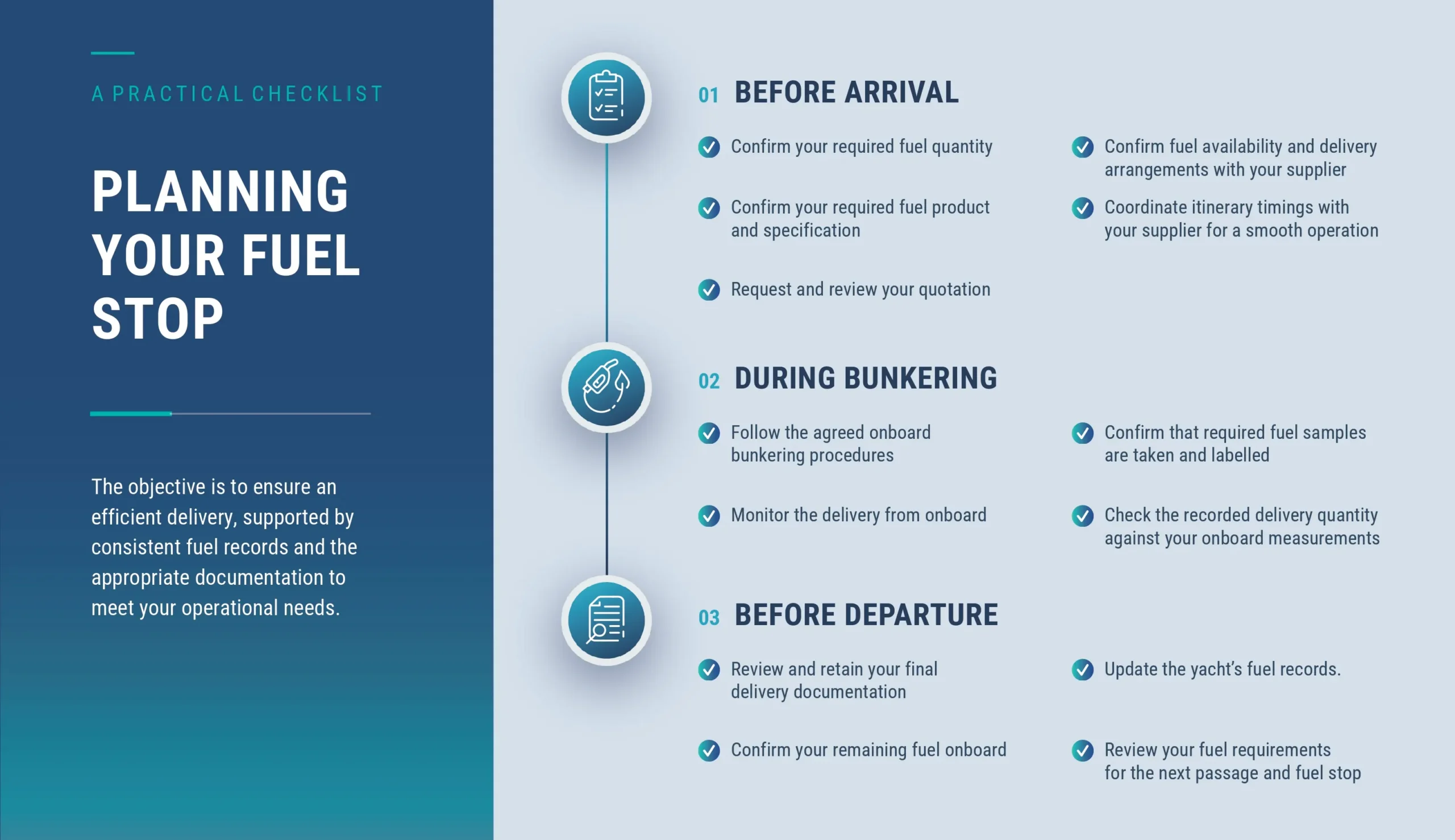
Planning Your Gibraltar Fuel Stop: A Practical Checklist
Before arrival
- Establish the required fuel quantity.
- Confirm the appropriate product and specification.
- Request and review the quotation.
- Confirm availability and delivery arrangements.
- Coordinate timing with the yacht’s itinerary.
During bunkering
- Follow the agreed bunkering procedures.
- Monitor the delivery.
- Complete required sampling and documentation.
- Verify the quantity delivered.
Before departure
- Confirm final delivery documentation.
- Update the yacht’s fuel records.
- Confirm remaining fuel onboard.
- Review requirements for the next passage and anticipated fuel stop.
The objective is not simply to complete the delivery efficiently, but to ensure that the fuel received, documentation and records are consistent with the yacht’s operational needs.
Peninsula’s Gibraltar Yacht Fuel Capability
Peninsula’s Gibraltar operation combines physical supply infrastructure with specialist knowledge of the superyacht sector.
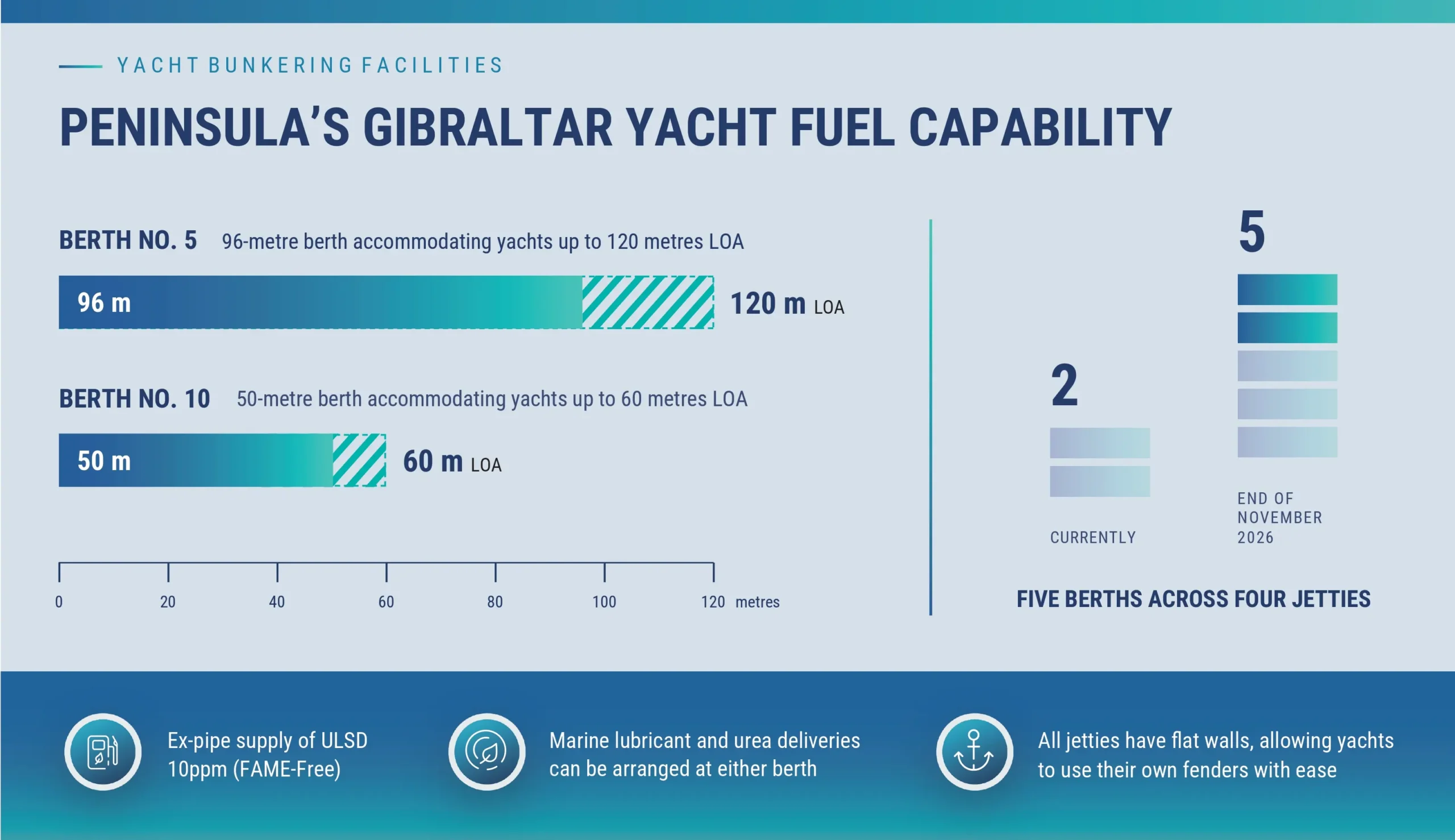
Its Superyacht Bunkering Facilities in Gibraltar provide ex-pipe supply of ULSD 10ppm (FAME-Free), with two berths currently available. The operation is expanding: an additional berth is expected by the end of October 2026, followed by two more by the end of November 2026, bringing the total to five berths across four jetties. Further expansion is also planned.
Berth No. 5 is a 96-metre berth accommodating yachts up to 120 metres LOA (length overall). Berth No. 10 is a 50-metre berth accommodating yachts up to 60 metres LOA. Marine lubricant and urea deliveries can be arranged at either berth.
All jetties have flat walls, allowing yachts to use their own fenders with ease. Each jetty is accessible by truck and taxi, making it straightforward to arrange crew changes, receive provisions and remove garbage while bunkering.
This physical capability supports yacht bunkering in Gibraltar alongside Peninsula’s wider marine fuel network. The company’s service model considers price, availability, quality, local facilities and operating conditions, providing a single point of contact for yacht bunkering requirements.
For captains and yacht managers, this means Gibraltar supply can be considered alongside the wider itinerary rather than in isolation. Product selection, availability, delivery timing and onward fuel requirements can all be assessed as part of one bunkering plan. After the yacht leaves Gibraltar, Peninsula remains available to arrange worldwide bunkering assistance in all ports, providing continuity of service.
Plan Your Gibraltar Fuel Stop with Peninsula
A yacht fuel bunkering operation in Gibraltar is most effective when fuel supply is considered alongside the vessel’s technical requirements, itinerary and onward passage. Peninsula combines physical supply capability in Gibraltar with specialist marine fuel knowledge and a global network, giving captains and yacht managers access to local expertise and broader market insight.
From confirming the appropriate product and availability to coordinating delivery and supporting fuel-quality control and traceability through the supply process, Peninsula’s approach is built around the requirements of the individual yacht.
For your next Gibraltar yacht fuel requirement, speak to Peninsula Yacht Services to discuss the vessel, itinerary and bunkering requirements with the team.
Frequently Asked Questions about Yacht Fuel in Gibraltar
Why is Gibraltar important for yacht bunkering?
Gibraltar’s position at the entrance to the Mediterranean makes it a practical bunkering location for yachts transiting between the Atlantic and the Mediterranean. It offers fully duty-free fuel for all yachts, alongside established marine fuel infrastructure and Peninsula’s physical supply capability.
What yacht fuels are available in Gibraltar?
ULSD 10ppm (FAME-Free) is supplied ex-pipe at Peninsula’s yacht berths in Gibraltar. Jet A1 can be delivered by dedicated bowser, subject to availability. HVO and petrol are not currently available in Gibraltar through Peninsula, although Peninsula can arrange HVO deliveries by truck on both the Atlantic and Mediterranean sides of the Strait. MGO is reserved exclusively for commercial deliveries by barge at anchorage. Marine lubricants, AUS 40 Marine Urea and AdBlue 32.5% urea solution can also be supplied, with pumping onboard included.
How should I plan a fuel stop in Gibraltar?
Confirm the required quantity, fuel specification and availability before arrival, then coordinate delivery timing, port requirements, sampling and documentation around the yacht’s itinerary.
Can large superyachts bunker in Gibraltar?
Peninsula’s Superyacht Bunkering Facilities in Gibraltar currently include Berth no. 5, a 96-metre berth accommodating yachts up to 120 metres LOA, and Berth no. 10, a 50-metre berth accommodating yachts up to 60 metres LOA. Expansion to five berths across four jetties is expected by the end of November 2026. Current berth availability and operational requirements should be confirmed with Peninsula when planning a delivery.
How does Peninsula support yacht fuel bunkering in Gibraltar?
Peninsula combines physical fuel supply in Gibraltar with a wider global marine fuel network. A local representative assists the yacht and its appointed port agent during the bunkering call, while the team coordinates product availability, quality, local conditions and delivery requirements through a single point of contact, with support available around the clock. Worldwide bunkering assistance remains available after departure from Gibraltar.