
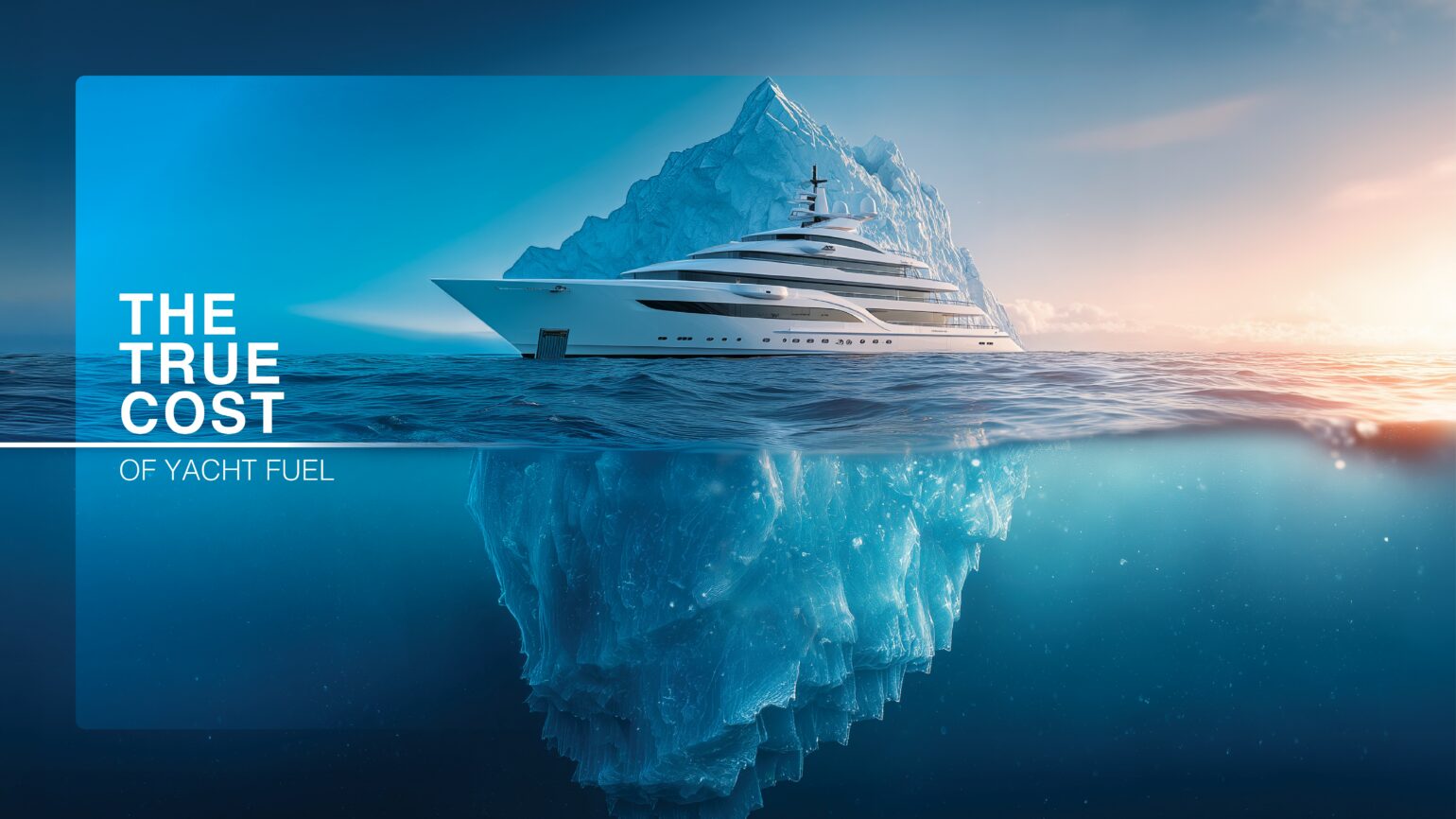
Fuel is one of the most significant operating expenses in yacht management. It is therefore understandable that owners and captains closely monitor marine fuel pricing. However, focusing solely on the price per litre can be misleading. The true yacht fuel cost extends far beyond the bunker invoice.
At Peninsula Yacht Services, we regularly advise clients who initially evaluate fuel decisions based on short-term price fluctuations. In reality, the most economical fuel strategy is determined not by today’s price, but by long-term performance, maintenance impact, reliability, and total cost of ownership.
A lower price per litre does not automatically mean lower overall cost.
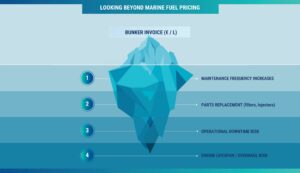
Looking Beyond Marine Fuel Pricing
Marine fuel pricing is influenced by global oil markets, supply logistics, regional availability, and taxation. Yet these external factors tell only part of the story. The internal consequences of fuel quality on your yacht’s engines and systems are often where the real costs emerge.
Lower-grade fuels can increase carbon deposits within combustion chambers, contribute to injector fouling, and accelerate filter clogging. Over time, this affects combustion efficiency and places additional strain on engine components. What begins as minor servicing adjustments can gradually lead to higher maintenance frequency, increased parts replacement, and in extreme cases, premature overhaul requirements.
Fuel quality also plays a measurable role in efficiency. Even marginal reductions in combustion performance can increase litres consumed per nautical mile. On a vessel operating hundreds or thousands of engine hours per year, a small percentage drop in efficiency translates into substantial additional fuel consumption. The apparent savings at purchase can quickly be eroded by higher usage.
Operational reliability is another critical factor. Suboptimal fuel may not cause immediate failure, but it can contribute to inconsistent engine performance, unstable exhaust temperatures, and reduced generator efficiency. For yachts operating on tight charter schedules or remote cruising plans, even minor disruptions can result in costly downtime.
Understanding Total Cost of Ownership
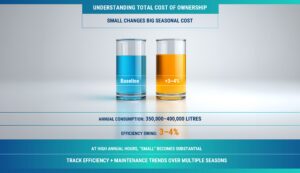
True fuel cost analysis must consider the full operational ecosystem of the yacht. This includes annual fuel consumption, servicing intervals, engineering labour, replacement parts, potential downtime, and long-term engine lifespan.
For example, if a yacht consumes 350,000 to 400,000 litres annually, even a 3–4% efficiency variation significantly alters total seasonal expenditure. Add to this the compounding effect of maintenance cycles, and the financial difference between fuel strategies becomes far more substantial than the headline price suggests.
Premium fuels often contain additive packages designed to maintain cleaner combustion and protect critical components. While the upfront cost per litre may be higher, the longer-term reduction in deposit build-up, injector wear, and unplanned maintenance can create measurable operational savings.
This is where a structured fuel strategy becomes essential. Without analysing performance data and maintenance trends over multiple seasons, it is impossible to accurately determine which option delivers the best financial outcome.
Fuel Choices and Return on Investment
Return on investment in fuel selection should be evaluated across multi-year ownership cycles rather than single bunkering decisions.
If a premium fuel costs a modest increment per litre, the annual additional expenditure may appear significant. However, when that same fuel improves efficiency, reduces engineering interventions, and helps preserve engine integrity, the financial equation changes. Avoiding a single major repair, reducing overhaul frequency, or preventing a missed charter booking can offset years of incremental fuel premiums.
Furthermore, consistent use of high-quality fuel supports better documented maintenance records. In an increasingly professionalised yacht market, detailed operational history contributes positively to resale value and buyer confidence.
Fuel strategy, therefore, is not simply an operational decision — it is an asset protection decision.
Calculating Long-Term Savings
Accurate fuel cost modelling requires analysis of cruising patterns, engine load profiles, generator hours, and historical maintenance data. It also requires an understanding of how the vessel is used: long-range passages, short coastal cruising, or intensive charter rotations all affect consumption behaviour differently.
When these operational realities are mapped against fuel quality and efficiency metrics, a clearer financial picture emerges. Rather than reacting to fluctuating marine fuel pricing, owners can make informed, strategic decisions aligned with their yacht’s usage profile and long-term ownership objectives.
Strategic Fuel Management with Peninsula Yacht Services
At Peninsula Yacht Services, we provide comprehensive fuel cost analysis tailored to each vessel. Our approach considers performance benchmarking, consumption modelling, maintenance trends, and long-term operational planning.
By evaluating yacht fuel cost through a total cost of ownership framework, we help owners and captains reduce hidden expenses, improve fuel efficiency, and safeguard engine longevity.
Fuel purchasing should never be a reactive decision driven solely by price. With the right analysis, it becomes a strategic lever for operational stability and financial efficiency.
If you would like a detailed review of your vessel’s fuel performance and long-term cost profile, contact Peninsula Yacht Services via our fuel consultation page and request your tailored fuel cost analysis.